



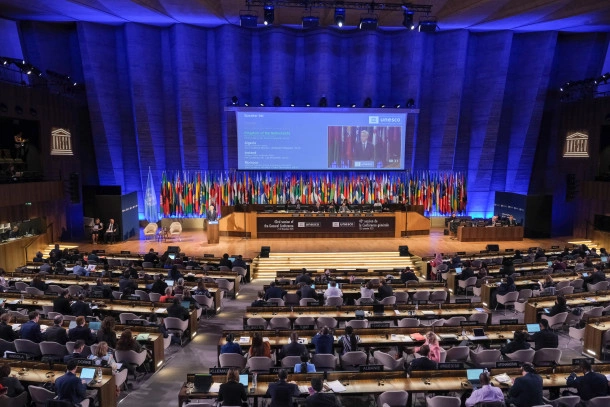
On Thursday November 9, starting at 10:00 A.M., an exceptional ceremony will be organized and broadcast live from UNESCO Headquarters in Paris to celebrate the 79th anniversary of UNESCO. Numerous heads of state and government and several internationally renowned artists will participate.
The High-level Segment of UNESCO’s General Conference focused on how the commons should be thought of and protected in the context of the major disruptions the world is currently experiencing, with a particular emphasis on climate disruption and digital transformation. The event was structured in two parts, one featuring a lecture by Prof. Dipesh Chakrabarty on the global public goods and how they need to be rethought in the face of the major disruptions the world is facing. In the second part, a high-level panel with prominent individuals from various areas demonstrated how UNESCO is using partnerships to tackle climate change and digital transformation for the benefit of both people and the planet.
The UNESCO General Conference, held in Paris from November 7 to 22, will celebrate the Organization’s 79th anniversary. Its 193 Member States will make a number of important decisions, particularly in relation to cultural policies and heritage protection, the future of education, and the place and ethics of science and technology in our societies.
The 42th session of the General Conference of UNESCO opened Thursday in Paris, during which the governing body of UNESCO will review program and policy plans aimed at achieving the 2015-2030 Sustainable Development Goals (SDGs).
Reiterating the Somalia’s commitment to achieving the 2030 SDGs, the minister of education, culture and higher education of Somalia H. E. Farah Sheikh Abdulkadir, addressed “UNESCO’s irreplaceable role in dialogue and peace building,” saying “governments need a dialogue on an equal footing between all countries and civilizations is more important than ever.”.
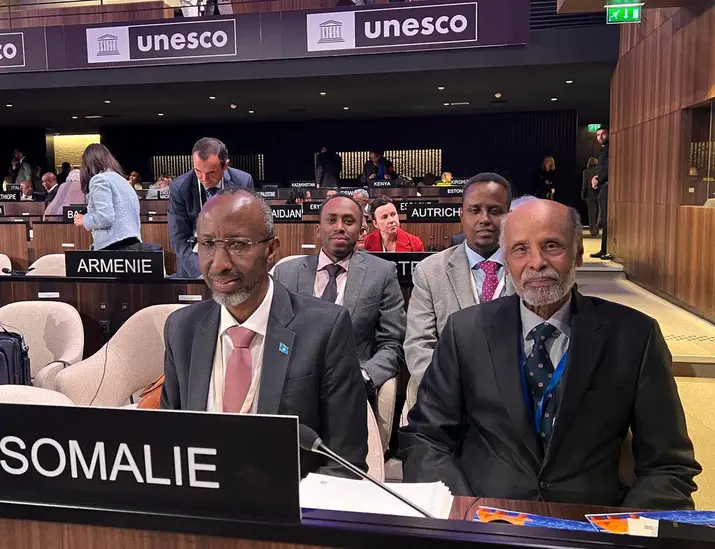
On the other hand, the Federation of Somalia Universities (FESU) is also invited to attend as CSO’s representing the private sector and her member institutions just to let them hear UNESCO’s voice and commitment towards helping Somalia’s higher education institutions before 2030 and after 2030.
Dr. Daud Abdi Daud who was attended the 42nd meeting through as hybrid as zooming said “As the sub-agency of the United Nations, UNESCO must take actions towards democratic support regarding higher education institutions and their membership to the International Association of Universities (IAU),” he continued, adding that “the promotion of building a well prepared and academic community of common destiny is not easy and without democratic cooperation it can’t be reachable with in inheriting of UNESCO’s purpose, yet also its her responsibility.”
FESU will continue to fight Somalia’s higher education institutions development and independent rights by reaching everywhere in across the globe.